
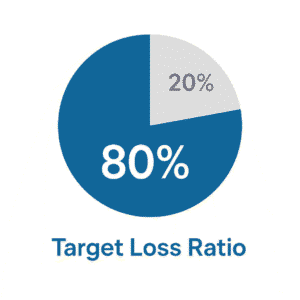
When you review your company’s employee benefits plan, you might hear the term “Target Loss Ratio” (TLR). It sounds technical, but it’s actually a simple concept that plays a big role in how insurance companies set your renewal rates.
Breaking Down the Term
“Loss ratio” = the percentage of premiums paid in vs. claims paid out.
Example: If your company pays $100,000 in premiums and employees use $80,000 in claims, the loss ratio is 80%.
“Target” = the level the insurance company wants that ratio to sit at in order to run the plan sustainably.
Why It Matters
Insurance companies need to cover more than just claims. They also have administration costs, risk charges, and in some cases, advisor compensation. The target loss ratio builds this into the plan.
For most small and mid-sized group benefit plans, the TLR usually falls between 70% and 85%:
If claims are above the target, expect a premium increase at renewal.
If claims are below the target, there’s room to negotiate a smaller increase or even a rate decrease.
A Simple Analogy
Think of it like running a restaurant:
You sell a meal for $20 (the premium).
It costs you $16 to buy ingredients (the claims).
That leaves $4 to cover rent, staff, and profit (the insurer’s expenses and margin).
If your food costs suddenly jump to $19, you’re losing money — so you raise your prices. Insurance works the same way.
What Plan Sponsors Should Watch
Look at your claims experience reports. Is your plan trending above or below target?
Don’t panic if one year is high — sometimes one-time claims (like a large drug expense) skew results.
Focus on the trend over time, not just one snapshot.
Key Takeaway
Target Loss Ratio is simply the insurance company’s benchmark for balancing claims and costs.
If your plan consistently runs above target, expect higher renewal rates. If it runs below, you’re in a stronger position to negotiate.
Understanding TLR helps you have a clearer, more confident conversation at renewal time — and ensures your plan stays both competitive and sustainable.